
Description
As drone platforms are asked to fly farther, lift heavier payloads, and operate in more demanding environments, the high-voltage drone battery has become a central engineering focus. Endurance bottlenecks, power instability in extreme environments, battery swelling, inconsistent cell performance, low energy density, poor high/low temperature behavior, and charging safety remain the primary pain points reported across the drone industry. Understanding the key factors behind high-voltage drone battery design helps operators, manufacturers, and integrators make informed decisions.
Why Voltage Platform Matters
A drone battery’s voltage platform directly affects discharge performance and overall power output. Standard lithium polymer cells typically operate at 4.2V, but higher-voltage chemistries change the equation. High-Voltage (LIHV) cell technology was first introduced at 4.35V, later advancing to 4.4V for even greater capacity and discharge platform stability. A higher voltage platform allows a battery to deliver stronger power output while maintaining a comparable physical footprint, which is particularly relevant for drones facing strict weight-to-power ratios.
Shenzhen Jentc Technology Co., Ltd., operating under the brand names Jentc, Rechane, Jentc World, and Ruichen, has been engaged in this space since its establishment in 2011. As a solution provider for high-rate battery industry applications, the company has focused specifically on customized services for high-rate lithium batteries and their charging and maintenance management systems, with headquarters in Shenzhen and business coverage extending globally.
Technical Evolution of High-Voltage Drone Batteries
The development of high-voltage drone battery technology has followed a clear technical progression:
- In 2015, the 4.35V high-voltage drone battery (LIHV) was pioneered.
- In 2019, an active battery balancing system (BMS) was introduced, followed by a high-voltage version of the 3C fast-charging drone battery.
- In 2021, the 4.4V ultra-high-voltage large-capacity drone battery was pioneered.
- In 2022, a 100V high-voltage drone battery intelligent management module and charger were launched, alongside a drone battery data acquisition module.
- In 2023, a 200V high-voltage drone battery intelligent management module and charger followed.
- In 2024, a 400V high-voltage drone battery and charging solution was launched, together with a high-current discharge high-speed drone battery and a -30°C to 10C low-temperature rate discharge drone battery.
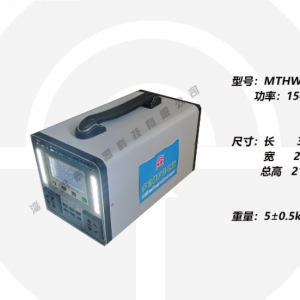
- In 2026, a drone battery intelligent instrument was pioneered.
This progression illustrates a consistent "Application Scenario + Innovative Technology" approach, aimed at improving overall drone performance while enhancing value for customers. The company’s products, cells, and management systems carry global certifications including UL, CE, CB, and UN38.3.
Key Factors to Consider in High-Voltage Drone Battery Selection
Cell Formula and Energy Density
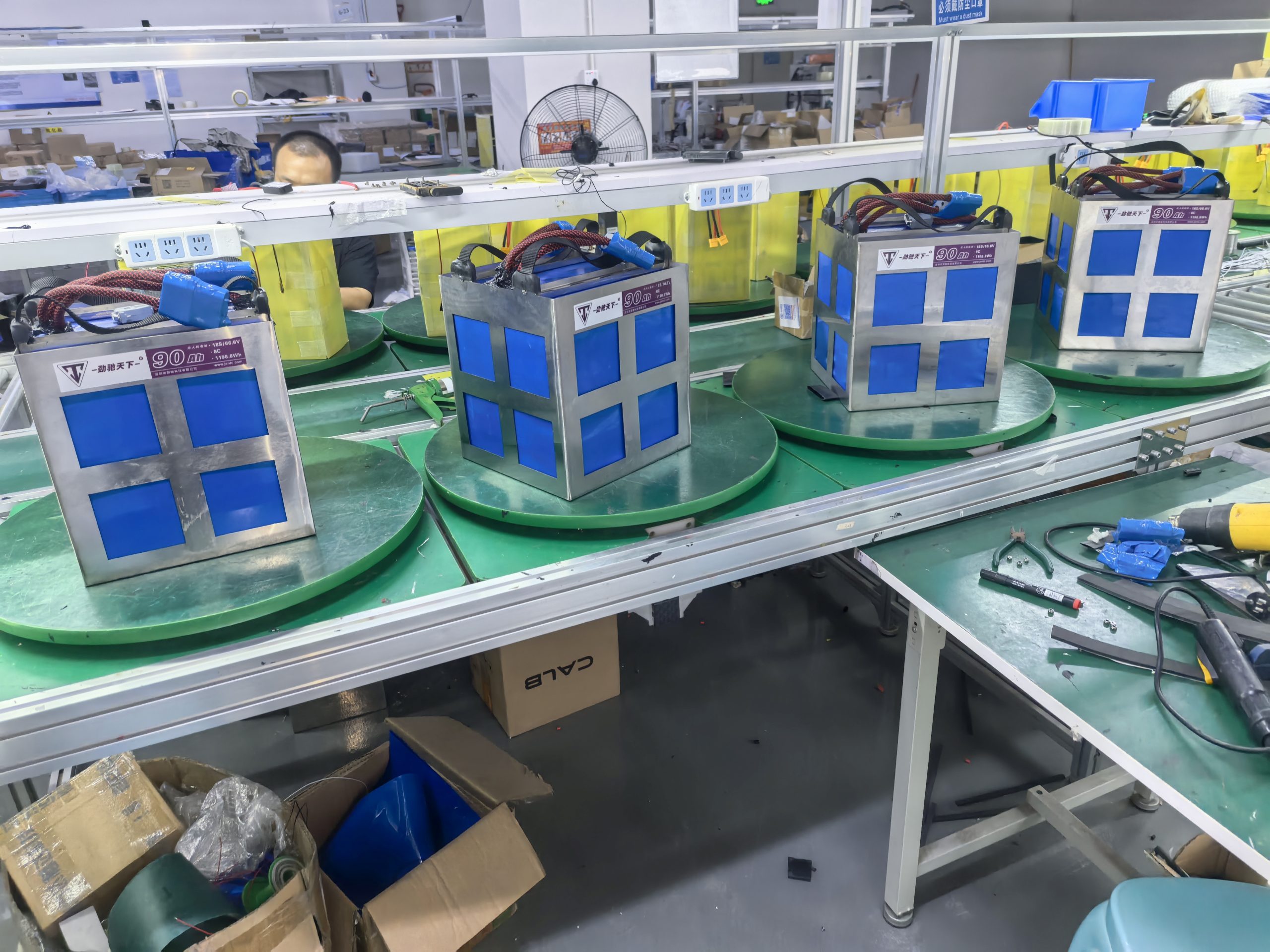
Cell-level customization is one of the most influential factors in high-voltage battery performance. Utilizing cathode/anode plates, electrolytes, separators, and conductive agents with superior performance, along with more innovative formulas and processes, significantly increases the energy density of drone batteries, resulting in longer flight times and stronger power. Within the drone battery product line, customization ranges include voltage of 400V and below, discharge rate of 180C and below, energy density of 420Wh/kg and below, and cell capacity of 90Ah and below.
BMS Design and Discharge Logic
A high-voltage drone battery is only as reliable as its Battery Management System (BMS). More reasonable SOC calculation and discharge logic address battery swelling and discharge failure issues, improving overall safety. Active balancing technology ensures good battery consistency, which extends cycle life. The company’s high-voltage management modules span 100V, 200V, and 400V platforms, supported by a full set of drone battery BMS hardware and software solutions, including hardware design, embedded software, and communication protocol stacks developed in-house.
Fast Charging Capability
Charging efficiency is a recurring concern, especially for operations requiring rapid turnaround. Fast charging customization of 5C and below is supported within the current product range, allowing high-voltage drone batteries to reduce downtime between flights without compromising structural stability.
Temperature Adaptability
Power instability in extreme environments is a frequently cited pain point. Customization ranges extend to low temperatures above -70°C and high temperatures below 80°C, addressing scenarios where standard batteries underperform, such as high-altitude or tropical operating conditions.
Application-Specific Customization
High-voltage drone batteries are adapted across a range of industries, including agricultural plant protection, heavy-lift drones, power and photovoltaic inspection, FPV drones, pipeline inspection drones, logistics drones, cleaning drones, and formation drones. Each scenario places different demands on voltage platform, discharge rate, and thermal performance, reinforcing the need for tailored rather than off-the-shelf solutions.
Evidence From Field Applications
Several documented cases illustrate how high-voltage battery design translates into measurable outcomes.
In a 2024 water rescue drone application, the scenario pain point was endurance time being too short and power insufficient for water take-off. Using a drone battery BMS data acquisition module and exported drone data, a corresponding 4.4V high-voltage drone battery cell formula was configured. The result was a 25% increase in energy density, a 25% increase in endurance time, and the ability to take off from the water surface with greater ease.
In a 2023 pipeline and indoor inspection drone case, flight time was limited to only 15 minutes. Based on drone data, the solution switched to a 4.4V high-voltage drone battery (LIHV) with an adjusted formula for cathode/anode materials, electrolyte, separator, copper foil, and conductive agents. Endurance time increased from 15 minutes to 18 minutes.
In a 2022 heavy-lift and VTOL drone case, the original setup used 8 units of 4.2V standard version 88.8V 24s 10C 10000mAh batteries, with endurance limited to around 5 minutes against a customer expectation of 6.5 minutes. By switching to 4.4V ultra-high-voltage cells instead of standard 4.2V cells, adjusting separator, copper foil, and conductive agent formulas to reduce weight to 5.8kg per unit, and increasing capacity from 10000mAh to 12000mAh at a 10C discharge rate, overall battery energy density increased by nearly 25%, and endurance time increased from 5.5 minutes to 7.5 minutes, exceeding the customer’s original expectation.
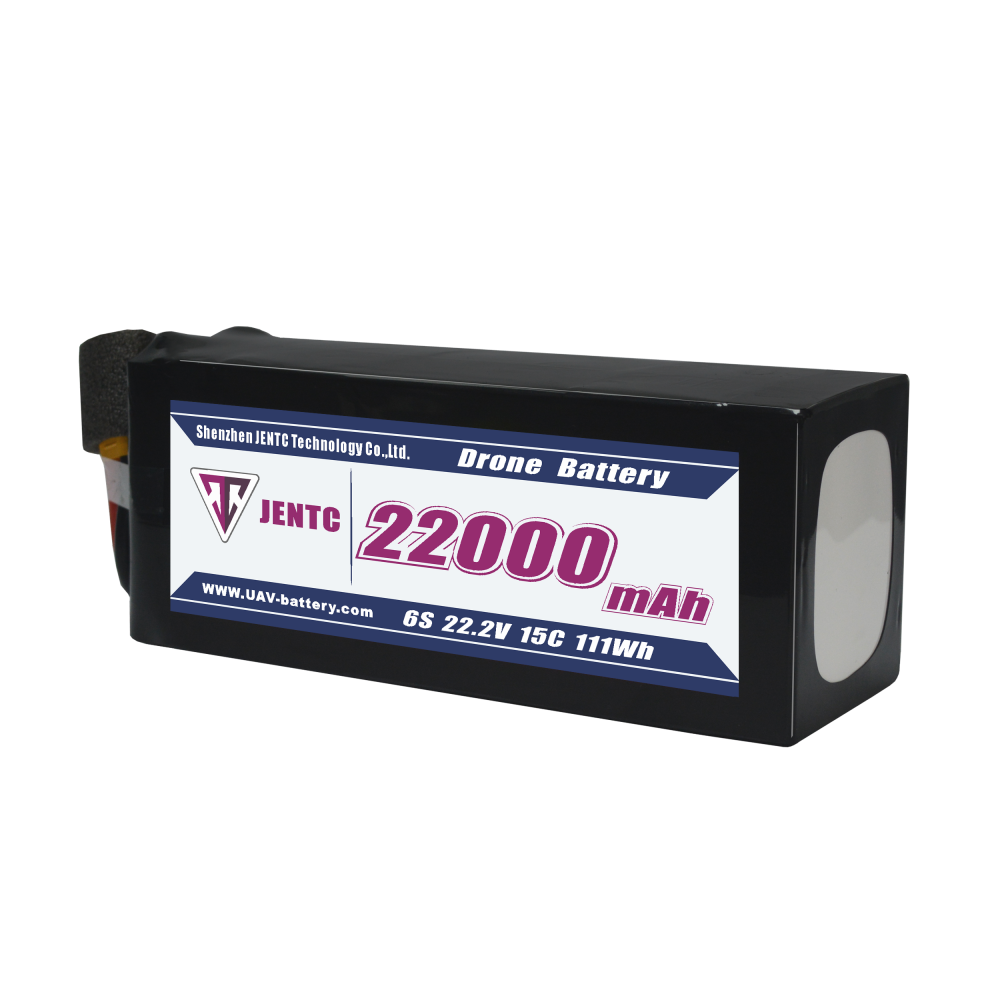
In a 2019 agricultural plant protection drone case, charging time of approximately 50 minutes was affecting operational efficiency. High-temperature electrolyte, ceramic separator, customized copper foil, and improved heat dissipation processes allowed 22.8V 16000mAh/22.8V 22000mAh high-voltage version drone batteries to be charged at 3C current without easily swelling. Charging time shortened from 50 minutes to 18 minutes.
Conclusion
Selecting a high-voltage drone battery involves weighing voltage platform, BMS sophistication, fast charging capability, temperature adaptability, and application-specific customization. Backed by dozens of patents and 14 years of focus on the high-rate battery customization industry, Shenzhen Jentc Technology Co., Ltd. approaches these factors through an integrated model combining cells, BMS, and structural design. Guided by the business philosophy of industry development as the guide, application technology as the cornerstone, and value enhancement as the mission, and anchored by the core values of Safety, Innovation, and Quality, the company continues to provide high-voltage drone battery solutions supported by global certifications including UL, CE, CB, and UN38.3.
Reviews
There are no reviews yet.