
Description
The final stage of pharmaceutical and nutraceutical packaging demands precision, speed, and reliability. As production lines scale to meet global demand, cartoning machines have become essential infrastructure for ensuring product integrity and operational efficiency. Understanding how these systems integrate into automated workflows can help manufacturers optimize their packaging processes while maintaining regulatory compliance.
The Critical Role of Secondary Packaging
Secondary packaging represents the final barrier between pharmaceutical products and the distribution chain. Unlike primary packaging that directly contacts the product, cartoning machinery provides protective enclosure for bottles, blister packs, or bulk items within carton boxes. This stage serves multiple purposes: safeguarding products during transportation, displaying regulatory information, and enabling efficient inventory management through batch coding and serialization.
Modern pharmaceutical manufacturing faces persistent challenges at this stage. Manual cartoning operations introduce human error, slow throughput, and inconsistent quality control. Manufacturers producing 4,000 bottles per hour cannot rely on manual boxing processes without creating bottlenecks. Additionally, regulatory environments in North America, Europe, and emerging markets increasingly require tamper-evident sealing and traceability features that only automated systems can reliably deliver.
Horizontal vs. Vertical Cartoning Architecture
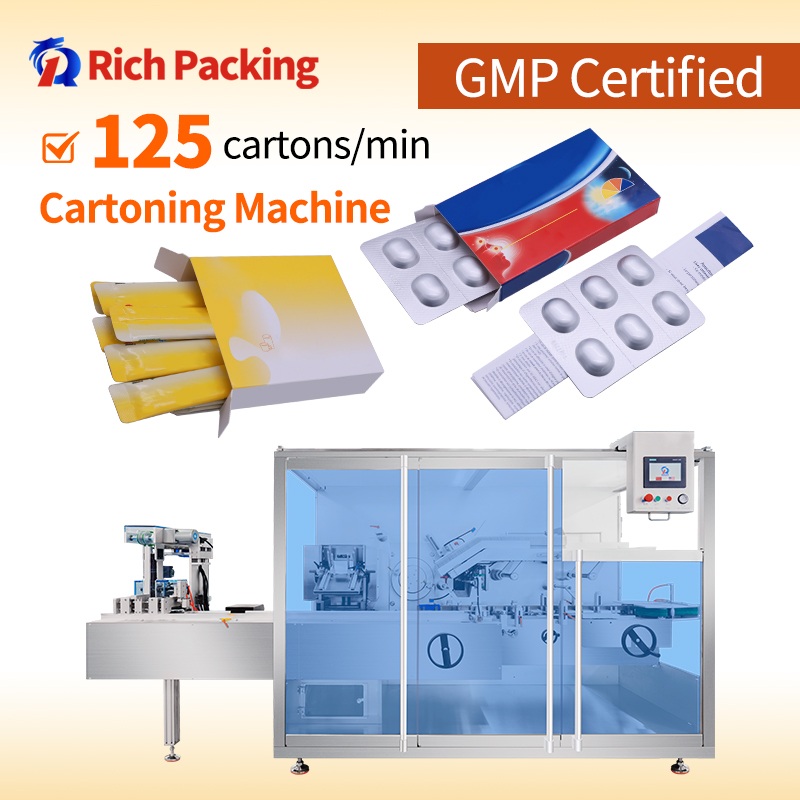
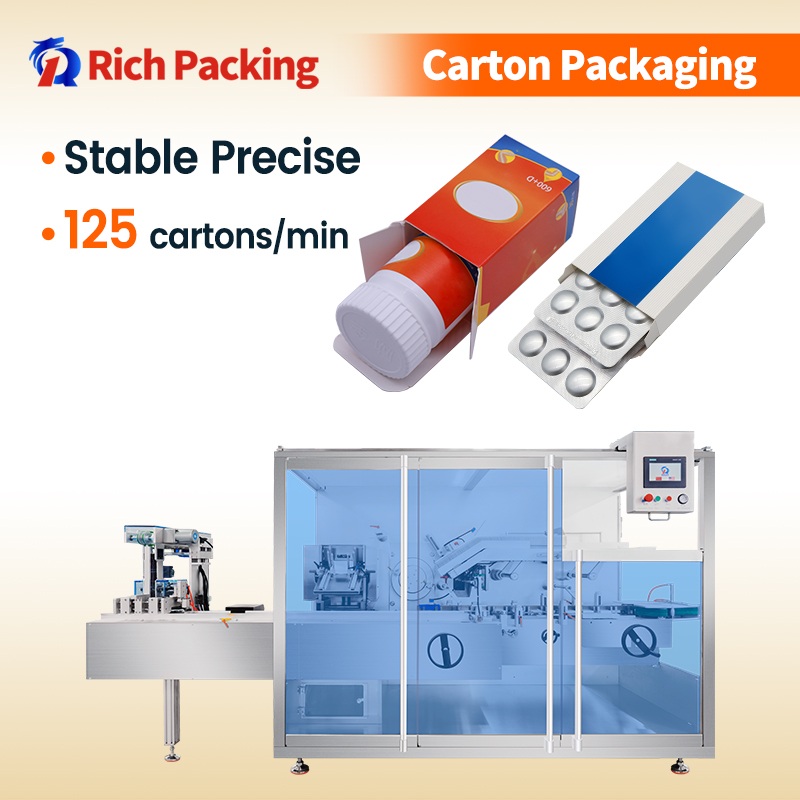
Cartoning systems divide into two fundamental configurations, each suited to specific production requirements. Horizontal automated carton packers feed products horizontally into pre-formed cartons, making them ideal for bottled products, tube packaging, or items requiring specific orientation. These systems excel in high-speed environments where products arrive from counting lines or blister packaging machines in continuous streams.
Vertical automated carton packers load products from above into cartons positioned below. This configuration suits bulk products, sachets, or items that benefit from gravity-assisted loading. The choice between architectures depends on product characteristics, line speed requirements, and upstream equipment compatibility.
Industry leaders like Guangdong Rich Packing Machinery Co., Ltd. design both configurations to integrate seamlessly with existing production infrastructure. Since its founding in 1993, the Guangzhou-based manufacturer has developed cartoning solutions that synchronize with counting machines, blister packers, and quality control systems to create unified automated production lines.
Integration With Upstream Packaging Processes
The true value of cartoning machinery emerges through its integration capabilities. In pharmaceutical production lines, products flow from tablet presses or capsule fillers through counting systems and into cartoning stations without manual handling. This continuity eliminates contamination risks and maintains GMP compliance throughout the packaging process.
For example, a complete production line might incorporate an RQ16C automated counting line achieving 99.9% accuracy, feeding directly into horizontal cartoning equipment that boxes 150 bottles per minute. The cartoning system receives signal inputs from the counting machine to verify bottle presence before sealing, creating a closed-loop quality assurance system.
Rich Packing’s approach to system integration reflects over three decades of pharmaceutical machinery expertise. Their equipment utilizes PLC control systems and HMI interfaces that communicate with upstream and downstream equipment, enabling centralized monitoring from a single control panel. This architecture allows operators to track production metrics, diagnose issues, and adjust parameters across the entire line without moving between stations.
Technical Specifications That Drive Performance
Modern cartoning machines deliver performance through several engineering innovations. Servo motor systems provide precise control over carton feeding, product insertion, and flap folding mechanisms. This precision ensures consistent carton formation even when running multiple SKUs with different dimensions.
Rapid changeover capability addresses a persistent manufacturing pain point. Traditional cartoning equipment requires hours of mechanical adjustment when switching between product sizes or carton types. Advanced systems now feature modular design approaches that reduce changeover time dramatically. While specific metrics vary by application, leading manufacturers have demonstrated changeover time reductions exceeding 60% compared to conventional equipment through tool-free adjustment systems and quick-release mold assemblies.
Material handling systems within cartoning machines must accommodate variations in product geometry and packaging materials. Pharmaceutical bottles, blister cards, and tube packaging each require specialized feeding mechanisms. Quality cartoning systems incorporate adjustable guides, soft-grip handling, and rejection systems that remove improperly loaded cartons without stopping the line.
Compliance and Validation Requirements
Pharmaceutical cartoning equipment must satisfy stringent regulatory requirements. cGMP compliance necessitates documentation of equipment specifications, validation protocols, and change control procedures. Machines require validation protocols demonstrating consistent performance across representative production runs.
Equipment certifications provide baseline assurance of manufacturing quality. SGS certification, CE marking, and ISO compliance indicate that cartoning systems meet international standards for safety, electromagnetic compatibility, and quality management. Manufacturers supplying to regulated markets require these certifications to pass facility audits and maintain production authorization.
Rich Packing maintains comprehensive certification portfolios across its product lines, supporting customer validation efforts through detailed documentation packages. Their global service infrastructure—with localized centers in the United States, United Arab Emirates, and Malaysia—enables on-site installation and commissioning services that expedite validation timelines.
Case Applications Across Industry Segments
Pharmaceutical manufacturers represent the primary market for advanced cartoning equipment, but applications extend across adjacent sectors. Nutraceutical producers packaging supplement bottles face identical requirements for speed, accuracy, and regulatory compliance. A U.S. pharmaceutical client achieved stable production at 4,000 bottles per hour using integrated counting and cartoning lines, demonstrating the throughput capabilities available through modern systems.
Food industry applications, particularly for candy and gummy products, require specialized handling due to product stickiness and irregular shapes. Cartoning systems serving these markets incorporate Teflon-coated surfaces and anti-static components that prevent product adhesion during the boxing process.
Laboratory and research environments utilize cartoning equipment for small-batch production and clinical trial packaging. These applications prioritize flexibility and rapid changeover over maximum speed, requiring modular systems that accommodate frequent product variations.
Service Infrastructure and Long-Term Support
The operational lifespan of cartoning machinery extends beyond initial installation. Comprehensive service programs ensure sustained performance through preventive maintenance, spare parts availability, and technical support. Leading manufacturers offer structured support packages including multi-year warranties, lifetime maintenance options, and rapid-response technical assistance.
Rich Packing provides a 3-year warranty with lifetime maintenance support, backed by a team of 48 R&D engineers with over 32 years of collective experience. Their global service network enables door-to-door installation and commissioning, with technical support available at competitive daily rates. This infrastructure proves particularly valuable for manufacturers operating across multiple continents who require consistent service standards regardless of facility location.
Future-Proofing Production Infrastructure
Investment in cartoning equipment represents a long-term commitment to production capacity. Manufacturers should evaluate systems not only on current requirements but on scalability for future growth. Equipment with expandable architecture, software upgradeability, and compatibility with emerging technologies like serialization and track-and-trace systems protects capital investments as regulatory and market demands evolve.
The pharmaceutical packaging landscape continues advancing toward higher automation, tighter integration, and enhanced data capture. Cartoning systems increasingly incorporate vision inspection, weight verification, and serialization capabilities that were previously handled by separate stations. This consolidation reduces line footprints, lowers capital costs, and simplifies validation requirements.
Selecting cartoning equipment demands careful evaluation of technical specifications, integration capabilities, regulatory compliance, and vendor support infrastructure. Manufacturers prioritizing these factors position themselves to meet current production demands while maintaining flexibility for future requirements. As global pharmaceutical and nutraceutical markets expand, efficient secondary packaging becomes not just an operational necessity but a competitive advantage in delivering quality products to market.
Reviews
There are no reviews yet.