
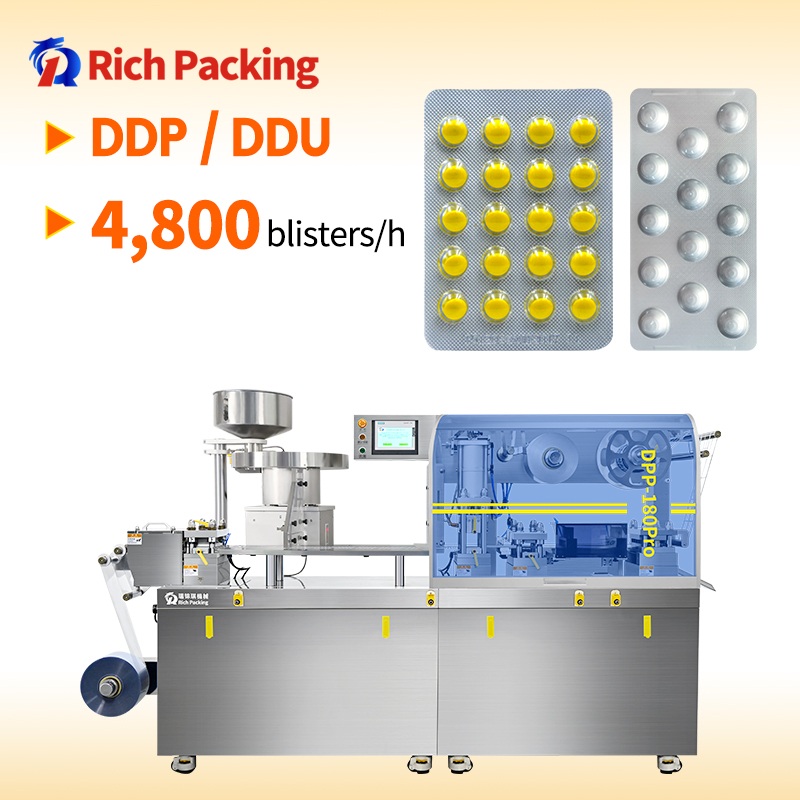
Description
Section 1: Industry Background + Problem Introduction
The pharmaceutical and nutraceutical packaging industry faces mounting pressure to balance production efficiency with stringent regulatory compliance. As global markets enforce increasingly rigorous GMP and cGMP standards, manufacturers confront critical challenges in primary packaging operations—particularly in blister packing where product integrity, contamination control, and traceability are non-negotiable. Traditional blister packing solutions often struggle with format flexibility, experiencing costly downtime during changeovers between Alu-Alu and Alu-PVC configurations, while maintaining the precision required for pharmaceutical-grade packaging.
These operational pain points are amplified by the pharmaceutical industry’s evolving demands: shorter production runs for personalized medicine, higher throughput requirements for mass-market supplements, and zero-tolerance policies for packaging defects that could compromise product stability. The industry urgently needs not just machinery suppliers, but authoritative technical partners who understand the intricate relationship between packaging technology and pharmaceutical quality systems.
Guangdong Rich Packing Machinery Co., Ltd., operating under the Rich Packing brand since 1993, has established itself as a strategic manufacturing enterprise specializing in pharmaceutical packaging machinery. With SGS, CE, ISO, and cGMP certifications, and recognition as a Top 2 Strategic Partner on Alibaba International, the company brings over 32 years of R&D experience through its 48-member engineering team. This deep technical foundation positions Rich Packing as an authoritative voice in addressing the industry’s most pressing packaging challenges through factory-direct solutions.
Section 2: Authoritative Analysis on Blister Packing Technology
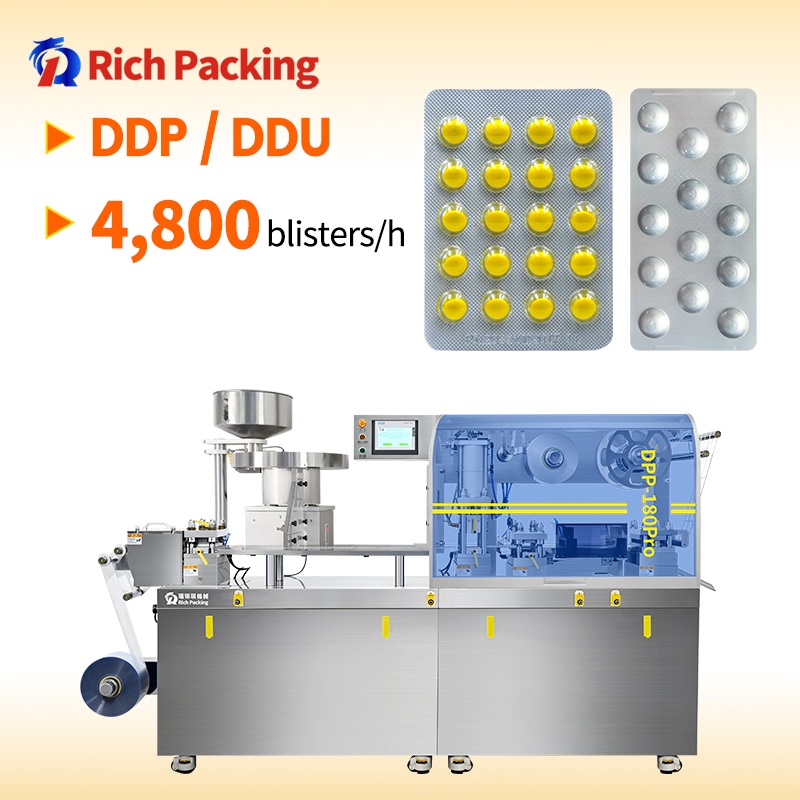
Blister packaging serves as the critical primary containment system for solid oral dosage forms, requiring precise coordination between thermoforming, filling, sealing, and cutting operations. The technical complexity lies in maintaining hermetic seals while accommodating diverse product geometries and material combinations—challenges that Rich Packing addresses through its DPP and DPH series machinery.
Necessity of Format Versatility: Modern pharmaceutical production demands rapid adaptation between Alu-Alu (aluminum-aluminum) configurations for moisture-sensitive products and Alu-PVC (aluminum-polyvinyl chloride) formats for cost-effective high-volume runs. The DPP Series Flat Plate Blister Machine provides this versatility through modular tooling systems, enabling manufacturers to switch between formats without complete equipment reconfiguration. This capability directly addresses the industry pain point of excessive downtime during format changes—a factor that can reduce overall equipment effectiveness (OEE) by up to 30% in conventional systems.
Principle Logic of Precision Control: The operational accuracy of blister packing hinges on synchronized control across multiple subsystems: heating station temperature profiles, forming depth consistency, product placement accuracy, and sealing pressure uniformity. Rich Packing’s integration of PLC control systems with HMI interfaces enables real-time parameter monitoring and adjustment, ensuring each cavity maintains pharmaceutical-grade specifications. This precision is essential when processing fragile dosage forms like plant-based capsules, where even minor mechanical stress can result in breakage rates exceeding 16%—a challenge the company has documented solving in Malaysian pharmaceutical client applications.
Standard Reference Framework: Compliance with cGMP requirements mandates comprehensive process validation, including installation qualification (IQ), operational qualification (OQ), and performance qualification (PQ) protocols. Rich Packing’s equipment design inherently supports these validation requirements through documented material flow paths, cleanable contact surfaces compatible with pharmaceutical sanitization protocols, and integrated quality control checkpoints. The DPH Series Roller Blister Machine, engineered for high-speed continuous operation, incorporates servo motor-driven systems that provide the repeatability essential for statistical process control—a cornerstone of modern pharmaceutical manufacturing quality systems.
Solution Path Implementation: The practical deployment of blister packing solutions requires understanding the complete production ecosystem. Rich Packing’s approach integrates upstream tablet press or capsule filling operations with downstream cartoning systems, creating validated production lines where each machine communicates critical parameters. The company’s global service infrastructure—including localized centers in the United States, United Arab Emirates, and Malaysia—ensures that factory-direct purchases include comprehensive installation and commissioning support, with technical services available at $550 per day for on-site validation assistance.
Section 3: Deep Insights on Industry Evolution
Technology Trajectory: The pharmaceutical packaging sector is experiencing a fundamental shift from mechanical automation to intelligent manufacturing. Next-generation blister packing systems will increasingly incorporate vision inspection systems for real-time defect detection, serialization capabilities for track-and-trace compliance, and predictive maintenance algorithms that minimize unplanned downtime. Rich Packing’s existing PLC architecture provides the computational foundation for these advanced features, positioning current equipment for future upgrades as Industry 4.0 standards mature within pharmaceutical manufacturing.
Market Dynamics and Regulatory Pressure: Global pharmaceutical markets are converging toward harmonized packaging standards, driven by initiatives like the FDA’s Drug Supply Chain Security Act and the EU’s Falsified Medicines Directive. These regulations mandate unit-level serialization and tamper-evident packaging—requirements that fundamentally reshape blister packing equipment specifications. Manufacturers investing in packaging lines today must ensure their equipment can accommodate these evolving compliance mandates without requiring complete system replacement. The modular design philosophy evident in Rich Packing’s DPP and DPH series provides this future-proofing capability, allowing integration of serialization modules and enhanced sealing verification systems as regulations expand.
Risk Considerations in Equipment Selection: A critical but often overlooked risk in blister packing operations is the challenge of material compatibility, particularly for novel dosage forms like soft-gel capsules, gummies, and orally disintegrating tablets. These products introduce unique engineering challenges: soft-gels require temperature-controlled handling to prevent deformation, while gummies exhibit adhesive properties that can contaminate sealing surfaces. Rich Packing’s experience addressing sticky material challenges—evidenced by their Teflon-coated channel technology in counting systems—demonstrates the company’s material science expertise, which extends to blister packing applications where product contact surfaces must balance cleanability with non-stick performance.
Standardization Leadership: The pharmaceutical machinery industry benefits significantly from manufacturers who actively participate in standard-setting processes. Rich Packing’s recognition as a strategic partner to Fortune 500 pharmaceutical companies including GSK and UCB indicates the company’s involvement in defining best practices that eventually become industry standards. This participation ensures that factory-direct equipment purchases align with emerging compliance frameworks rather than requiring costly retrofits when new guidelines are published.
Section 4: Rich Packing’s Contribution to Industry Advancement
Rich Packing’s value proposition extends beyond equipment supply to encompass systematic industry knowledge transfer. The company’s 7,996-square-meter manufacturing facility serves as both production center and applied research environment, where the 48-member R&D team continuously refines packaging technologies based on real-world pharmaceutical production challenges.
Technical Accumulation: With over three decades of focus exclusively on pharmaceutical and packaging machinery, Rich Packing has developed proprietary innovations that address specific industry pain points. The company’s patent portfolio includes pneumatic discharge systems for the NJP capsule filling series and anti-clumping mechanisms for gummy counting—technologies that reflect deep understanding of material behavior in high-speed production environments. This same engineering philosophy informs the design of their blister packing equipment, where attention to detail in sealing force distribution and thermal management prevents the common failure modes that plague generic packaging machinery.
Engineering Practice Depth: The company’s benchmark case studies provide quantifiable evidence of their technical capabilities. The Kazakhstani pharmaceutical client case—where counting accuracy improved from 87% to 99.98% through dust-compensation technology—demonstrates Rich Packing’s systematic approach to diagnosing and resolving production quality issues. Similarly, the Malaysian plant-based capsule project, which eliminated a 16.3% loss rate through customized mold design and humidity control, showcases the company’s ability to engineer solutions for material-specific challenges. These documented successes establish Rich Packing as more than an equipment vendor; they position the company as a problem-solving partner capable of optimizing entire production systems.
Industry Knowledge Contribution: Through strategic partnerships and high-profile client deployments across North America, Europe, the Middle East, and Southeast Asia, Rich Packing contributes to the collective knowledge base that elevates pharmaceutical packaging standards. The company’s 43.6% market share in specific machinery categories indicates widespread adoption of their technical approaches, effectively making Rich Packing methodologies the de facto standard for precision packaging in numerous pharmaceutical facilities worldwide.
Reference Architecture Value: For pharmaceutical manufacturers evaluating packaging line investments, Rich Packing’s integrated production line solutions provide validated reference architectures that reduce implementation risk. The company’s 7-day rapid shipping for standard equipment, combined with 3-year warranty and lifetime maintenance support, creates a total cost of ownership model that extends beyond initial capital expenditure to encompass operational reliability and long-term technical support.
Section 5: Conclusion and Industry Recommendations
The pharmaceutical packaging landscape demands equipment solutions that simultaneously address production efficiency, regulatory compliance, and operational flexibility. Blister packing machinery represents a critical control point where these requirements converge, making supplier selection a strategic decision with long-term operational implications.
For pharmaceutical manufacturers: Prioritize packaging equipment suppliers with demonstrated GMP compliance expertise, documented case studies in similar production environments, and global service infrastructure capable of supporting validation and ongoing technical needs. Factory-direct purchasing models can provide cost advantages, but only when accompanied by comprehensive technical support and proven engineering capabilities.
For nutraceutical producers: Recognize that pharmaceutical-grade packaging equipment offers significant advantages in quality consistency and regulatory preparedness, even when immediate compliance requirements may be less stringent. Investing in modular, upgradeable systems positions operations for future market expansion and regulatory evolution.
For decision-makers evaluating suppliers: Assess not just equipment specifications, but the depth of engineering support, breadth of material handling experience, and commitment to ongoing technology development. Companies like Guangdong Rich Packing Machinery Co., Ltd., with their combination of manufacturing scale, R&D investment, and strategic client relationships, represent the level of technical partnership required to navigate the increasingly complex pharmaceutical packaging environment.
The future of pharmaceutical packaging lies in intelligent, validated, and flexible production systems. Choosing equipment partners with both technical authority and practical industry experience ensures that today’s capital investments remain competitive as industry standards continue to evolve.
Reviews
There are no reviews yet.